Ulaan Baatar is the largest city in Mongolia. Almost 1/3 of the total population of Mongolia lives in the capital. It shows very much the Russian influence: Large avenues and large squares with momentous monuments in Russian style.
People live in all parts of Mongolia, including the Gobi desert. In the desert there are mainly nomadic families. They graze their life stock for a couple of weeks in one area and then move on to another place. We visited several local families in different parts of the country. A family usually has a couple of gers and some life stock. Outside of the few cities people live almost exclusively in gers. Even in the cities many people put up gers instead of houses. The gers are tents that can be taken down in about ½ hour and put up in 1 hour. They are usually nicely decorated and quite comfortable. In the winter they add a few more layers of felt or hide to the ger to insulate it, a wood burning stove provides the heat. People there still get around mostly on horseback, although many have motorcycles too. For life stock they have horses (still their main mode of transportation), cattle (often yaks), goats and sheep. Except in the northern parts they also often have camels, the two-humped Bactrian Camel (Camelus bactrianus, german: Trampeltier, french: Chameau de Bactriane).
During the Russian period, almost all of the Buddhist monasteries were destroyed and tens of thousands of monks were killed. Only three monasteries survived, one of them was the largest one in Kharakhorum, Erdene Zuu Hiid. Kharakhorum (Kharkhorin) was the ancient capital of Mongolia under Genghis Khan. The monastery in Ulaan Baatar was another one that survived. Buddhism is now coming back. Mongolian Buddhism was influenced very much by Tibet. This can be seen in a lot of the older paintings in the few monasteries that were left by the Russians. There was also some influence from India in some of the paintings.
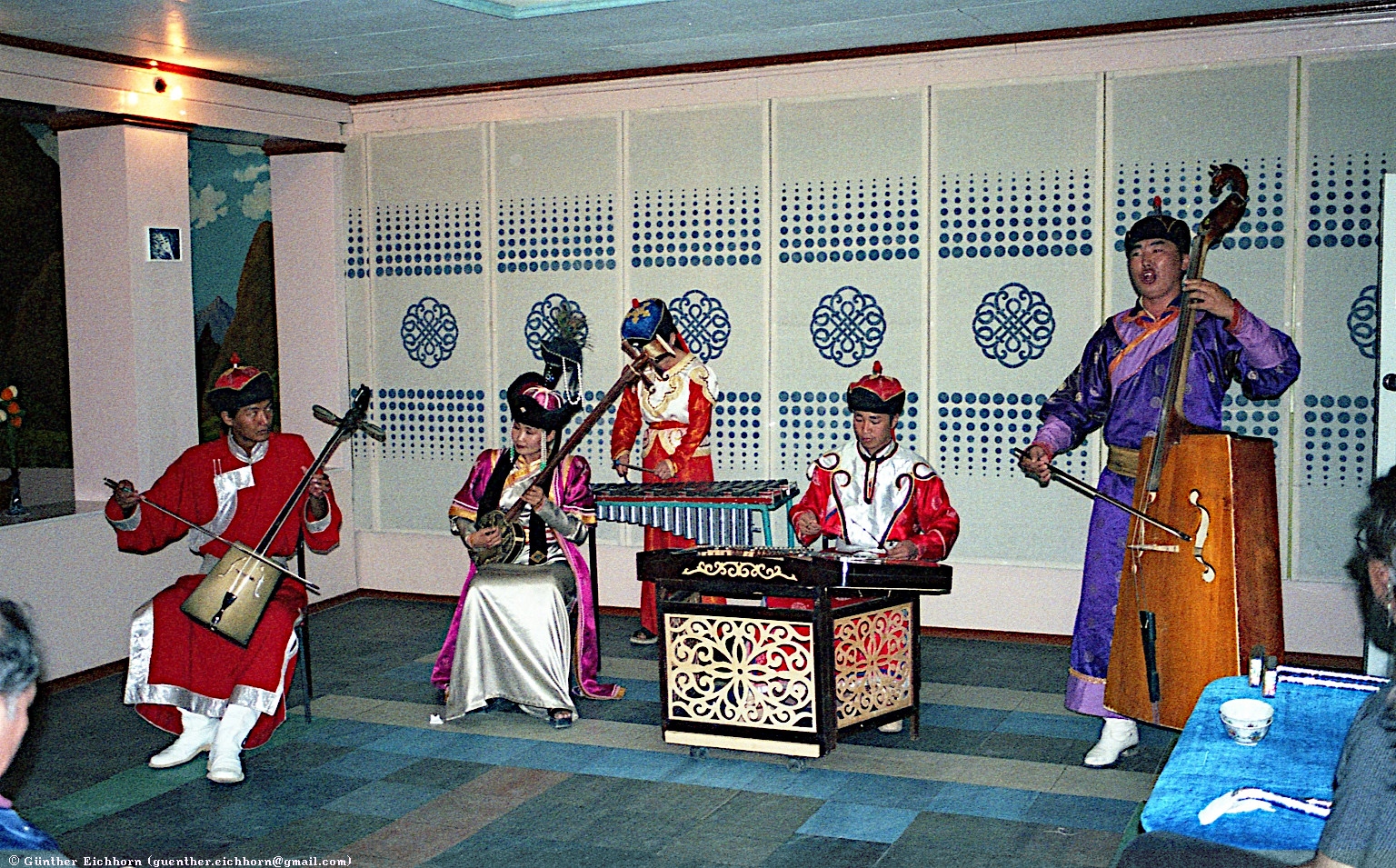
On one occasion I saw a Mongolian culture show. The music is different from other countries that I have visited. One part of it is very unusual: The throat singing. It is done by men in a very high voice. It takes long training to become good in this type of singing. The acrobats are, as usual, quite impressive. They reminded me of similar performances in China.
Almost all roads in Mongolia are just tracks. Only around Ulaan Baatar are a few paved roads. Driving over those tracks can be bone-jarring at times. When the track didn't go in the right direction we just drove where we wanted to go without tracks. This worked quite well in the Gobi desert with plenty of flat areas, but was a little more difficult as soon as you got into mountainous areas. There were very few bridges, mostly we just drove through the small rivers. Driving under these conditions takes its toll on the vehicles. Our drivers had to fix something almost every evening. They were pretty good mechanics and were able to get everything working pretty quickly. We had only one major fatality, the Mitsubishi bus, whose engine gave up. They had spare parts flown into the Gobi desert, but couldn't fix it in time. They replaced the bus with a Russian jeep so we could continue with the trip.
Throughout Mongolia you see so-called ovoos. These are sacred mounds of stone and other stuff with blue khadags (prayer scarves). They are shamanic symbols. It is customary to walk around an ovoo clockwise and throw stones or other objects on the mound for good luck with the journey. Our drivers did this regularly whenever we stopped at an ovoo (which was very frequently, since they are everywhere).
In the northern parts of Mongolia we saw several Stone Age monuments, like standing stones or stone circles. They are believed to be about 2,500 to 3,000 years old. They were probably erected by the Tsaatan, reindeer herders in northern Mongolia. We visited one group of reindeer herders near Lake Khövsgöl. There are not many of the nomadic Tsaatan left, many of them have settled in villages.
Throughout Mongolia people there is a mix of people in traditional Mongolian clothes and in western style clothes. Outside the cities people wear a lot more traditional clothes. (948k) A wedding party. (967k) A man in traditional Mongolian dress, including the pointed hat. (751k) Typical Mongolian pointed hat. (614k) An old man from one of the families that we visited. (647k) A woman with one of the families in the northern parts of Mongolia. There is a large number of women that I found very attractive in Mongolia, quite different from what I saw in China. (896k) The local family that we visited. (940k) Picnic. (1062k)
Transportation
A rider on his way to somewhere. The horses are quite small, but they cover good ground when they get going. (873k) A saddled horse with one of the colorful Mongolian saddles. For some reason they tie down the horses overhead. The horses can't reach the ground when they are tied like that. (994k) A Mongolian saddle. It is made out of wood. Notice the silver buckles right where you are sitting. Ouch!! I heard horror stories about how uncomfortable these saddles are. (1329k) Young kids on horseback. (747k) Young kids on a camel. (1022k) A saddled Bactrian camel. (1087k) Motorcycles are used a lot. (983k) This is one of the roads that we took. (995k) The tracks along which you drive tend to multiply. Anytime there is too big a hole in one track, people just make a new one next to it. Here you see an example of such a spread-out road. (666k) The Russians built some roads and bridges, but they are not maintained very well. We had to go through the river again to get around this one. (1135k)
Business
This lady had a cell phone and was sitting somewhere in Ulaan Baatar providing public phone service. There were quite a few of these entrepreneurs in the city. (998k) There were several Internet places in Ulaan Baatar. Outside of the capital however, there wasn't anything like that. (978k)
Agriculture and Livestock
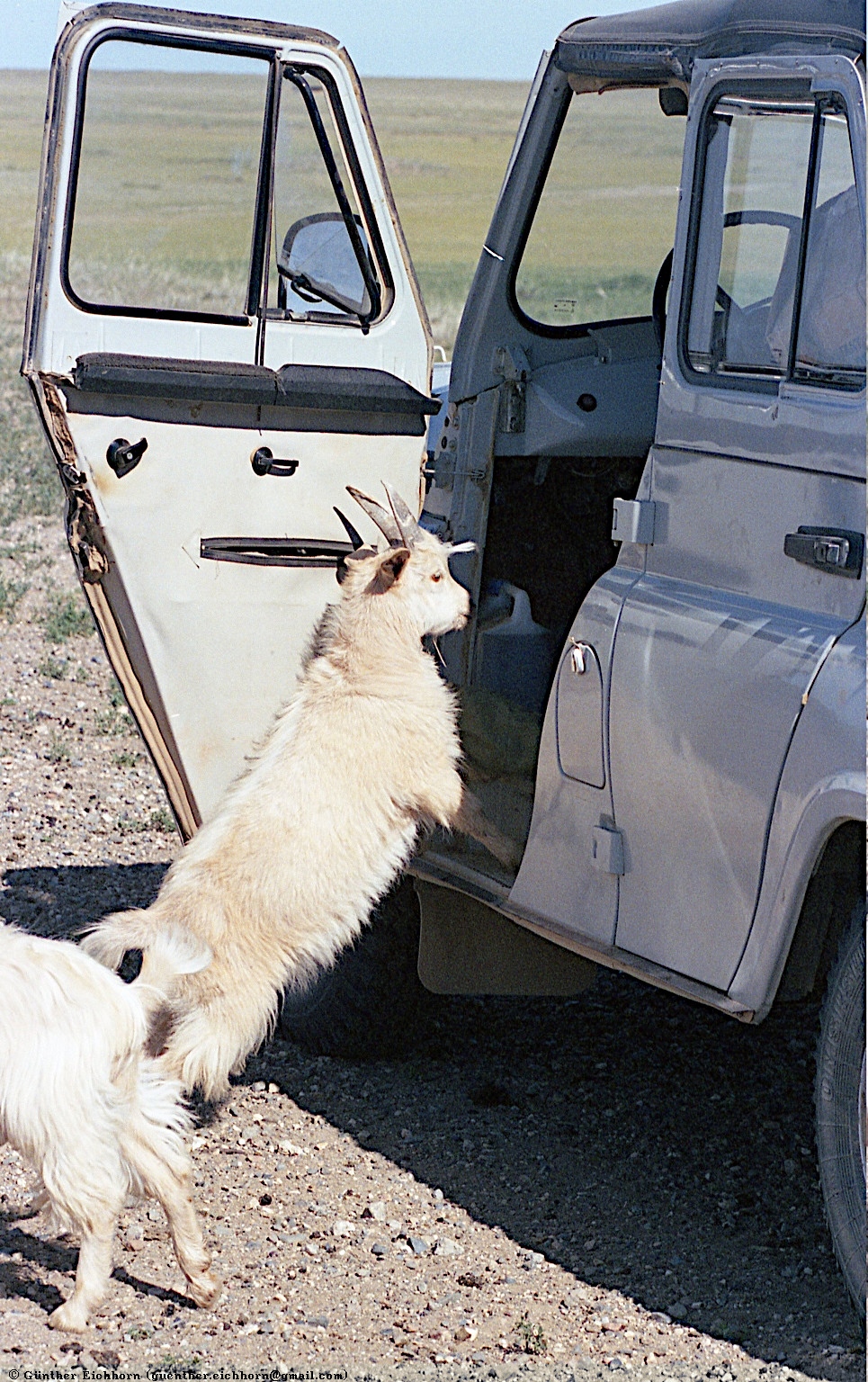
A herd of horses with a herder on horseback. (830k) The herders carry a very long pole (~ 6 m (20 ft) long) to direct the animals. When they want to catch an animal they have a noose at the end of the long pole. (691k) Horses at a watering hole. (695k) The cattle in Mongolia are mostly small domesticated Yaks (Bos grunniens, german: Yak, french: Yack). They are better suited for the long, cold winter than our cattle. (1115k) Yaks. (961k) Yak. (1004k) Yak. (947k) A camel herd in central Mongolia. (763k) Camels are used as draft animals as are cows. (1080k) Head of a camel. (968k) One tribe in northern Mongolia, the Tsaatan, raises Reindeer as their main type of animals. (1166k) Close-up of a reindeer. (1030k) Children ride the reindeer. (1137k) Herds of goats (foreground) and sheep. (941k) They had tied down the sheep in a long line for milking. (999k) Goats are curious critters. This one was very interested in what was in our car. (930k) There were carcasses of life-stock everywhere. This one had just the skin and bones left. Mongolia had an extremely severe winter 2000/2001. Many of the dead animals died during that winter. (1056k) Sometimes all that was left were scattered bones. (1266k) A waterhole in the Gobi desert. (978k) Pumping water was done either by hand or with one of the animals. This was one of our drivers showing us how it is done. (867k)
Entertainment
Local entertainment. (889k) A group playing traditional Mongolian music. The man with the base was the throat singer. (1190k) The throat singer with the base. (1118k) A mandolin player in traditional festive clothes. (1231k) Mandolin player. (957k) Dancer. (1098k) Singer. (1237k) A young girl doing acrobatics. It was quite amazing how she could tie her body into knots. (1153k) Acrobat. (1212k)
Cities and villages
Sukhbaatar Square in the center of Ulaan Baatar. (780k) Soviet style monument. (787k) One of the Soviet style monuments with an ovoo next to it. It was an interesting contrast between the huge monument and the shamanic ovoo. (848k) There are lots of ger suburbs around Ulaan Baatar. The gers are usually surrounded by wooden fences. These fences are there to provide protection from the wind. Strong winds are blowing most of the time, in the winter they can get very fierce. (988k) Outside of Ulaan Baatar, this is what towns look like. (890k) One of the villages we saw in central Mongolia. (1022k)
Nomadic Camps
Camp of a nomadic family in central Mongolia. (875k) A single ger in the Gobi desert with life stock. (577k) A group of gers just after sunrise in central Mongolia. (958k) Ger camp. (791k) A scene at a ger camp. (803k) A single ger in the Gobi desert. You can see that there is almost no vegetation. And still the life stock can feed for a few days before they move on. (815k) Desert camp. (755k) A typical ger. The ger has a wooden door and a wood frame that is covered with felt and fabric. To keep everything in place they wrap rope around the vertical walls. The top is open but can be covered with a flap of cloth to keep the rain out. (831k) The inside of the ger of a local family that we visited. Everything is nicely decorated and painted, the floor is carpeted. The two posts hold up the central ring of the roof. (1028k) Wood stove in a ger. (1172k) Nicely painted center top ring and supports in a ger. (1121k) The reindeer people, the Tsaatan, in northern Mongolia use these types of tents. (1193k)
Religious and Historic
There are many Stone Age relics in Mongolia. This was not marked, but the circular row of stones with the pile of stones in the center was obviously artificial. We saw pictures of Stone Age sites in the museum that looked very much like this site. (1079k) Stone Age Monument. There was a family camping there. They had traced the carvings with paint. This is not graffiti, it seems to be common in Mongolia. These monuments still are significant for Mongolians. (1190k) These are the ruins of one of the monasteries that the Russians destroyed. Over a thousand monks lived there when it was still alive. (1219k) The remains of one of the buildings in the destroyed monastery. (971k) One of the buildings in the Bogd Khan Palace in Ulaan Baatar. (917k) Closer view of the decorated roof of the building in the Bogd Khan Palace. (881k) Closeup of the paintings on the door of the Bogd Khan Palace Doors. (1106k) Roof decorations on the Bogd Khan Palace. (642k) The Bogd Khan Palace with the city in the background. (1032k) The Erdene Zuu Hiid monastery in Kharakhorum. There are 108 stupas around the monastery, 108 being a lucky number in Buddhism. (946k) Several of the stupas. (802k) Erdene Zuu Hiid. (1074k) Erdene Zuu Hiid. (1010k) Entrance gate to Erdene Zuu Hiid. (851k) Stupas at Erdene Zuu Hiid. (1025k) One of the stupas at Erdene Zuu Hiid. (1108k) The main temple in Erdene Zuu Hiid. (1006k) A temple in Erdene Zuu Hiid. (1072k) A temple in Erdene Zuu Hiid. This one is the oldest in the monastery, it dates probably from the 17th century. (867k) Roof decorations on a temple in Erdene Zuu Hiid. (700k) Beautiful tapestry with demon motif in Erdene Zuu Hiid. (1296k) Beautiful tapestry with demon motif in Erdene Zuu Hiid. (1287k) Beautiful tapestry with demon motif in Erdene Zuu Hiid. (1336k) Beautiful tapestry with demon motif in Erdene Zuu Hiid. (1402k) Beautiful tapestry in Erdene Zuu Hiid. (1310k) Large prayer drum in Erdene Zuu Hiid. (853k) Iron incense burner. (725k) Decorated metal vessel. (977k) A sign in one of the temples with various scripts. The bottom part is the old Mongolian script, with one row of Chinese at the very bottom. As far as I know the top two rows are in Tibetan. I don't remember what the next two rows are. (1150k) A Buddha statue in one of the temples. (1333k) A Buddha statue in one of the temples. (1310k) Buddha paintings. (1139k) Demon statue, standing on a human body. (1208k) A demon figure. This is a female demon. You can see a dismembered human body at the bottom. Some of these demons were not very nice people. (1303k) Turtle rock in Kharakhorum. Four of these rocks marked the ancient perimeter of Kharakhorum. (1116k) Prayer wheels in the Ganhan monastery in Ulaan Baatar. People walk by and spin the prayer wheels as part of their prayers. (776k) Buddhist monk. (874k) A Buddhist monk on the cell phone. (936k) Buddhist monks in the main monastery in Ulaan Baatar. They ring that gong in regular intervals. (766k) One of the ovoos, the shamanic stone mounds that you can see everywhere. You can find all kinds of stuff on these ovoos, including bottles, car parts, crutches, animal skulls, sometimes even money. (1018k) Crutches and other stuff on one of the ovoos. (1240k) In the northern parts of Mongolia the ovoos are much neater. The stone mound inside is the same, but it is then covered with wooden poles. This one was one of the nicest ones with a fence around it. (1097k)
Our tour group
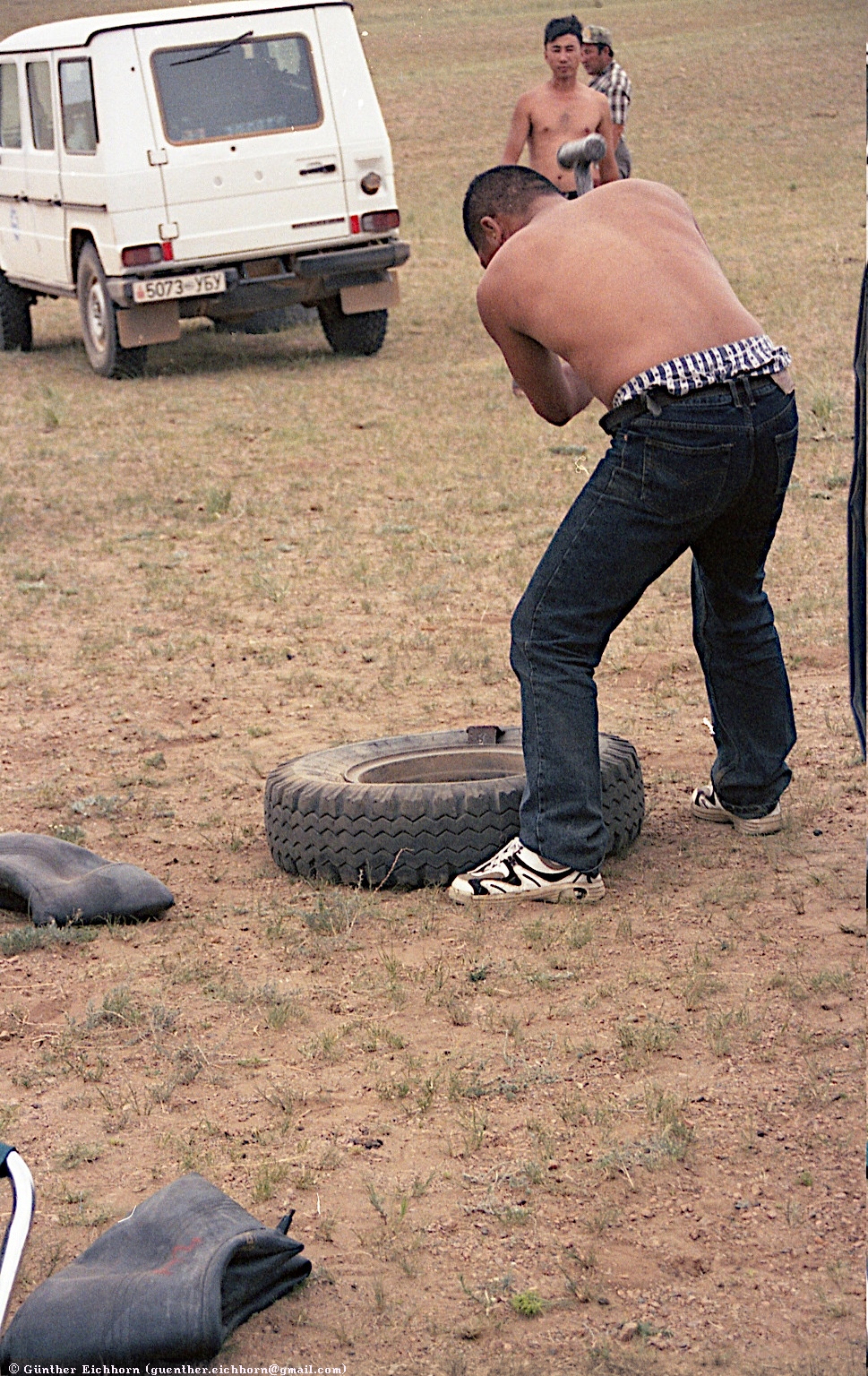
These were the vehicles that our group used and the drivers of the vehicles. (1424k) This was our camp in the Gobi desert. The large tent is the kitchen tent. (1214k) The Mongolian cook, preparing our meal. (902k) We managed to buy beer often enough, but how to keep it cold? When we had a mountain stream around, it was no problem, otherwise you just have to get used to drinking warm beer. (1270k) Instead of hotels there are ger camps like this in a lot of places. I stayed in such ger camps half the time instead of staying in the cold, wet tent. (1019k) It rained a lot. This is a view of our camp in the rain in the Gobi desert. (709k) Coming up a mountain track. (1024k) Lots of dust, especially in the southern desert areas. (759k) And I mean LOTS of dust. The whole valley was filled with dust blown up by the vehicles. (993k) The heat created impressive mirages over the flat parts of the desert. (873k) We had to stop many times with flat tires. (859k) Fixing a flat tire. They had it down pat, it happened often enough with the road conditions. (994k) Fixing a flat tire. (976k) This tire had a big hole in the sidewall, so they stuck the valve of a bad inner tube through the hole to plug it. (922k) Something broke in the oil distribution system. It took the drivers a few hours to fix that. We went ahead with two of the vehicles to our camp and the others followed once they had fixed the car. (1095k) Driving through a swamp area with water spraying. We got through this one OK. (939k) We did not get through this one. The Landcruiser got stuck in the mud here. It was rescued by the Mercedes which had locking differentials and could pull even on muddy ground. (880k) The Mercedes to the rescue. (1113k) Again the Mercedes came to the rescue when the Pajero got stuck on a big boulder while fording this river. (1258k)








 Dr. Günther Eichhorn Travel Website
 Soaring website